Thursday, April 12, 2007


R.I.P. Kurt Vonnegut, Jr.

A sad day in the literary world ...

Here is the Associated Press article:


NEW YORK - In books such as "Slaughterhouse-Five," "Cat's Cradle," and "Hocus Pocus," Kurt Vonnegut mixed the bitter and funny with a touch of the profound.

Vonnegut, regarded by many critics as a key influence in shaping 20th-century American literature, died Wednesday at 84. He had suffered brain injuries after a recent fall at his Manhattan home, said his wife, photographer Jill Krementz.

Vonnegut's more than a dozen books, short stories, essays and plays contained elements of social commentary, science fiction and autobiography.

"He was sort of like nobody else," said fellow author Gore Vidal. "Kurt was never dull."

A self-described religious skeptic and freethinking humanist, Vonnegut used protagonists such as Billy Pilgrim and Eliot Rosewater as transparent vehicles for his points of view.

[...]

Vonnegut once said that of all the ways to die, he'd prefer to go out in an airplane crash on the peak of Mount Kilimanjaro. He often joked about the difficulties of old age.

"When Hemingway killed himself he put a period at the end of his life; old age is more like a semicolon," Vonnegut told the AP.


One of the best quotations from Vonnegut comes from this article from the New York Times:

[...] To Mr. Vonnegut, the only possible redemption for the madness and apparent meaninglessness of existence was human kindness. The title character in his 1965 novel, "God Bless You, Mr. Rosewater," summed up his philosophy:

"Hello, babies. Welcome to Earth. It's hot in the summer and cold in the winter. It's round and wet and crowded. At the outside, babies, you've got about a hundred years here. There's only one rule that I know of, babies - 'God damn it, you've got to be kind.' " [...]

Monday, April 09, 2007


David Shenk, The Immortal Game: A History of Chess

When my son Matthew was six years old, I taught him how to play chess.

Today, as a ten-year-old chess player, he's pretty good and has competed in a few tournaments. Like bowling and baseball, I hope that chess will become a lifelong interest for him and, some day, be one of the things he'll teach his own children.

This past fall he participated in his school's chess club, which prompted me to look into a few books related to chess strategy, openings, endgames, and -- most interesting to me, personally -- the history of the game.

Shenk's The Immortal Game is an excellent read for anyone who is not only intrigued by the game's centuries of development, but also interested in the pragmatic tactics of specific matches. Shenk provides a readable account of the game's development, from its origins in Persia and Egypt through its growth in medieval Europe to its metaphorical significance throughout modern history, all the while exploring the game's unique hold on the human mind at particular points in history: the significance of how the pieces developed over time (e.g., the "Bishop" was once the "Fool"), the ways in which the game came to represent the human condition at certain historical moments (e.g., the Enlightenment's distaste for monarchy led to the development of Pawn importance), and a variety of such innovations to a game that has captured the hearts and minds of players for centuries.

Interspersing the history, Shenk focuses on the play-by-play action of the "Immortal Game," an actual match that took place in London on June 21, 1851 between Adolf Anderssen and Lionel Kieseritzky, two of the world's top chess players at the time. By giving the reader an actual competition to follow, the author maintains two narratives simultaneously: the "big picture" history of the game, and the "personal" account of how the game is opened, developed, and won (or lost) via its manipulation of time, space, and simple human skill.

If you dig chess, this is a great read! The Immortal Game comes with an accompanying website (and I'm hoping to beat my esteemed colleague after over a month of play action!). Check them both out!

Um ... and for a quick chess fix, go here.

Enjoy!

-----------------------------------

P.S. It's spring break and, between re-reading both Beloved and Bleak House, I'm hoping to squeeze in a Philip K. Dick novel and a Miles Davis biography. Wish me luck!

Monday, February 19, 2007


Cormac McCarthy, The Road

Simply put: haunting and gut-wrenching.

A man and his young son traverse the ashen wastelands of what was once America. Nuclear holocaust has devastated everything save a few roads and the occasional farm or abandoned city, and the two nameless protagonists move relentlessly westward in the hopes of reaching the ocean coast, all the while scavanging for food and shelter, or avoiding cannibalistic marauders.

Unlike McCarthy's masterpiece, Blood Meridian, there is no cast of colorful characters, no gruesome episodes of seemingly senseless violence, and no satanic Judge Holden from which to ascertain a moral (?) center. The Road is richly poetic despite its simplicity of style, and the "adventures" (such as they are) show a noticeable depth of character in both man and son as the narrative progresses. And while this is hardly the "feel good" book of the year, it remains surprisingly hopeful in the face of all that you, as a reader, suspect will happen by novel's end.

It took me about one full day to read this novel. It will grip you firmly about the neck during the reading, and linger with you long afterwards ...

Most powerful thing I've read so far in 2007, quite frankly! Check it out.


Sunday, February 18, 2007


Naguib Mahfouz, Palace Walk

Here's a book that I finished last week for February's Biblioholics Anonymous gathering. It was quite an enjoyable read!

Palace Walk may seem like an antiquated throw-back to the great Victorian novels of old, with its brilliant evocation of a faraway setting and its exotic characters. Yet it tells a compelling story -- that of Ahmad Abd al-Jawad, respected middle-class merchant to friends and acquaintances, but fiery-tempered patriarch to his own family. The novel, which is actually Book One of Mahfouz's "Cairo Trilogy" and is set in Egypt just after WWI, centers around al-Jawad, a highly traditional husband and father who maintains strict control over his family by way of the Qur'an while joyously seeking the pleasures of nightly trysts and carousing with friends. When his subserviant wife Amina dares to leave the house one day during his absence to visit a local shrine, she is involved in an accident that she cannot hide from her husband (and his fierce temper). One by one, wife and children must cope with the father's temper and hypocrisy as the novel takes us through marriage ceremonies, British occupation, and even family tragedy.

It is often said that Mahfouz does with Cairo in his fiction what Dickens did with London or Dostoyevsky did with St. Petersburg in their respective works. He offers an objective glimpse into the minds and hearts of his characters, and in the process exposes the universality of their culture, religious beliefs, and overall value system -- things which may seem remote and alien to Westerners, especially in these times.

If you are looking for a multi-cultural novel that shows just how dysfunctional all families can be, Palace Walk is a good pick. In fact, I place this book on the same "family dysfunction" shelf as Anne Tyler's Dinner at the Homesick Restaurant and Louise Erdrich's Love Medicine.

(I plan to read Book Two of the Cairo Trilogy -- Palace of Desire -- later this year.)

Saturday, February 10, 2007


Rachel Cohn & David Levithan, Nick & Norah's Infinite Playlist

A colleague recommended this book to me.

Said colleague mentioned that it's a book which has received many accolades since its publication last year, and it epitomizes what "young readers really look for in a good book."

Apparently, young readers must look for pseudo-hip dialogue that ridiculously drops the f-bomb like a comma; emotionally needy narrators who dwell on their insecurities and continuously wonder if they're homosexual; a storyline that takes place over the course of one night (James Joyce, anyone?) and is told through the alternate-chapter points-of-view of the two protagonists (William Faulkner, anyone?); and fiction that succeeds in doing little more than capture the ranting zietgeist prattlevoice of the typical adolescent boy and girl as it whines about music, parents, sex, substances, sex, insecurities, and sex.

Nick & Norah's Infinite Playlist tells of one night in the life of the title characters, two Manhattan high school seniors who have just emerged from failed relationships and come to meet at a performance of their favorite band. Complete strangers when they hook-up in an effort to make Nick's ex jealous, they begin a long night of conversations and meanderings through the streets of New York City, confronting their own obsessions, insecurities, and issues as their relationship develops.

It's an entertaining premise for a story, and the authors execute the storytelling in a back-and-forth manner which would seem clever and innovative to less erudite readers. If anything, each of the two narrators has a distinctive voice, and their musings are sprinkled with pop culture references galore, and enough obscenities to pass as a realistic slice-of-life of the average adolescent: Charles W. Chestnut capturing 2007 teen angst, if you will.

But "good" books do more than merely entertain you with a slice-of-life. They do more than offer what you already know. They teach. They inspire. They affirm. They challenge. One would hope that they make you a slightly ... oh so slightly ... "better" person by the end of the reading because they've taught ... or inspired ... or affirmed ... or challenged. And here is where Nick & Norah fails: it panders precisely to what young readers know already (and the more insecure ones will want vindicated), but it doesn't transcend beyond that. Even by the time the couple come to learn the Jewish concept of tikkan olam, it's too little too late.

Sadly, reading this book was one of the most misspent two hours of my week.

Wednesday, February 07, 2007


Happy Birthday Charles Dickens!


. . . born on this day in 1812.


Woo-hoo!


Sunday, February 04, 2007


Laurie Halse Anderson, Fever 1793

Here's a pretty good book for YA girls. It follows the story of fourteen-year-old Matilda Cook, whose mother owns Cook's Coffeehouse in 1793 Philadelphia just as the yellow fever epidemic strikes the city. Spreading quickly from the ports into the city itself, the fever forces residents to take to the roads, and when her mother begins to exhibit symptoms and is whisked away to the country residence of family friends, Mattie and her elderly Grandfather are left to their own devices to seek shelter and medical attention as soon as possible.

Fever has a solid story with plenty of page-turning episodes to keep young readers engaged, including the appearance of two murderous burglers, the acquisition of a young waif named Nell, and even a little romance with (sigh!) Nathaniel Benson! What I liked best here, however, was the story's basis in historical fact: its descriptions of the cruel treatment of fever victims by the common people, how doctors both here and in Europe treated the disease differently, and Anderson's use of enough Appendix-laden material to qualify this novel as clearly a piece of YA historical fiction.

Predictably, of course, we have the young protagonist who begins the novel with a certain set of values and, because of a life-altering experience, is now a much more "grown-up" individual by novel's end. It's fine to offer younger readers that sort of life-affirming storyline, but it's becoming so formulaic to me this year (after having read Soldier's Heart, Under the Same Sky, and Touching Spirit Bear) that I'm actually on a search at this point for something ... I don't know ... different.

Nevertheless, Fever is a good book, especially for young female readers. Check it out!


Tuesday, January 16, 2007

Good article came my way this morning. Thought I'd share it:

Please, I want some more Dickens
A fruitless search for the author at schools and on teen reading lists inspires a parent's literary crusade.
By Janine Wood

DEERFIELD, ILL.
Do you know any seventh graders reading "Great Expectations"? If not, maybe you should. In his book, "The Educated Child," former Education Secretary William Bennett suggests the Charles Dickens novel be part of a seventh- and eighth-grade reading list. I referred to Mr. Bennett's list recently while helping my 12-year-old son choose a book.

"Great Expectations!?" Now that's expecting a lot, I thought. I remembered picking it up on my own in eighth grade. But would adolescents today read Dickens in their leisure time? Maybe Mr. Bennett's book, written seven years ago, had made an impression. I called a local librarian. No, she said, "Great Expectations" is not a hit.

Next I polled my neighbors' children. Seventh graders on my block weren't reading "Great Expectations." They weren't reading "A Tale of Two Cities," "David Copperfield," or the "Pickwick Papers" either.

"Classics are stupid," said one 13-year-old girl, whose desperate mother had tried paying her to read Louisa May Alcott's "Little Women." "I'd have to buy my son 17 North Face jackets before he'd look at a classic," said another mother.

Why did Bennett's recommendation seem so far-fetched? Yes, television, iPods, and computer games interfere with reading, but was that the only explanation? Maybe the Dickens novel was simply too hard to find. I wanted an answer.

First, I visited the children's section of the library. The books displayed most prominently in the center of the room addressed contemporary social issues such as anorexia, homelessness, divorce, and poverty. I finally found some by Dickens tucked away toward the back of the room.
I left the library and wandered over to the local bookstore. While I relaxed with a book by the 19th-century essayist Thomas De Quincey, a middle-aged woman entered and asked a saleswoman for a book recommendation.

"Do you want chick lit, a page-turner, or a romance?" the saleswoman asked. Oh, how I wish she had asked, "Do you want Charles Dickens, Emily Brontë, or the latest translation of 'The Iliad'?" I felt as though I were at Wal-Mart instead of the bookstore, and that prompted me to wonder what other adults were reading. I asked around at the bookstore's cafe. Nobody had read Dickens since college and even then it was a chore. "I hated all that detail," one woman complained.

Then I scoped out the bookstore's teen section. Risqué images graced the covers of books with titles such as "Skinny Dipping" (second in the "Au Pairs" series) and "Gossip Girl." For boys, there were paperbacks that looked more like computer games than books – glossy covers depicting space ships and intergalactic battles.

"It's all teen trash," said the mom who had tried bribing her daughter to read "Little Women." "I might as well buy her a 'Harlequin Romance.' " How could the little black and white sketches of chubby men smoking pipes that appear in the older editions of Dickens compete with sexy girls romping on beaches?

"The answer is obvious," said a local father of two high school girls. "Teachers don't read Dickens, so they don't assign him." And sure enough, I looked at my son's past summer reading list and Dickens wasn't there. Neither were Mark Twain, Robert Louis Stevenson, or Stephen Crane. It seemed clear: For students in junior high, Dickens doesn't exist – not in book groups, not in schools, not at the library, and not at home. "Bah, humbug," I growled, and went off on a search for Mark Twain.

Parents, start a revolution! Unplug all electronic gadgets and get your children reading great books again. Here are a few tips:

• If "Great Expectations" seems too difficult, read the first few chapters aloud. Ask your child to read the rest.

• Ask your child to read at least 75 pages before giving up.

• Listen to classics on tape.

• Ask librarians to make the classics more visible to children.

• Start a children's book group. Gather a few children together. Meet at a local bookstore. The discussion doesn't need to be long – 10 minutes will do.

• Get in touch with the Great Books Foundation, which offers a list of age-appropriate books and instructions for guiding discussions.

Together, we can save Dickens – and others like him – from extinction!


• Janine Wood is a homemaker and writer.


http://www.csmonitor.com/2007/0116/p09s02-coop.html
Monday, January 15, 2007


Henry Hitchings, Defining The World: The Extraordinary Story of Dr. Johnson's Dictionary

Back in 1988 at Saint Xavier University, I took a class taught by Dr. John Buck (a visiting professor from Penn State University) on Reformation and 18th Century literature, which introduced me to the writings of Swift, Pope, Fielding, Smollett, Sterne, Defoe ... and Dr. Samuel Johnson. Since then, I've always had a fondness for the well-balanced turn-of-phrase and satirical wit of those 18th Century writers.

Hitchings's Defining The World is a pure celebration of all things Dr. Johnson. The opening chapters are devoted to a thumbnail sketch of his biography (mostly via Boswell); the majority of the book focuses on Johnson's planning, writing, researching, and building of the Dictionary, and the final chapters discuss its publication, subsequent editions, and overall impact on lexicography. Throughout, Hitchings sprinkles an abundance of sample words and their definitions from the Dictionary as he discusses Johnson's method of composition, professional relationships, personal demons, etc. And the author does a solid job of documenting the various ways in which Johnson's methodology set the standard by which all later dictionaries would be made (for example, the hierarchy of definitions per word and the use of literary passages to illustrate differences in meaning were Johnsonian innovations).

What I enjoyed most here was how much Hitchings obviously relishes the Dictionary despite its many flaws (which Hitchings is pretty upfront about). To undertake the writing of a reference work of this magnitude is a challenge for a committee, let alone one man. But Johnson devoted seven years to its composition, and flaws are inevitable (some of the definitions he wrote were ridiculously obtuse, others just plain wrong, and still others were amusingly snide). But Johnson's Dictionary, for all its imperfections, was an impressive feat at the time and, until the OED came along in the late nineteenth century, was the foremost reference of its kind in English (recall that Becky Sharp even reacts against it in Thackeray's Vanity Fair).

A few years ago I read Simon Winchester's The Professor and the Madman: A Tale of Murder, Insanity, and the Making of the Oxford English Dictionary, which was excellent! If you're interested in the stories behind these two English dictionaries (which, I'll admit, might not seem to be all that "interesting" until you see for yourself!), I'd recommend the Winchester and Hitchings books.


Sunday, January 14, 2007


Five Biographies of Charles Dickens

I might as well include these books on this list because for the past two years I've been in the slow process of reading five different biographies of Charles Dickens:

1. K. J. Fielding, Charles Dickens: A Critical Introduction (1965)

2. Fred Kaplan, Dickens: A Biography (1988)

3. Stephen Leacock, Charles Dickens (1933)

4. Edgar Johnson, Charles Dickens: His Tragedy and Triumph (two volumes, 1952)

5. Peter Ackroyd, Dickens (1990)

As I continue reading and teaching the complete novels of Dickens with my ongoing Newberry project, I find that I've settled into a pretty solid routine when writing my lecture notes on Dickens's biography.

For each pair of novels I teach (e.g., the 1849 - 1853 period that comprises the publications of David Copperfield and Bleak House), I read the appropriate sections of each biography in turn and take notes as I go. I then organize those notes into the appropriate number of sessions devoted to each book, and type up the notes accordingly. At the moment, I'm about halfway through each biography.

I usually begin with the Ackroyd and Johnson biographies because of their abundance of detail. I'm able to get most of my lecture material from those two, followed by the Kaplan bio (which is actually getting better now with the mid-point in Dickens's career). I then fill in the details by reading the Fielding and Leacock biographies which, though they aren't very engaging and are mostly cursory, provide a few anecdotes here and there. If time permits, I might return to scan each book in the weeks prior to the start of a seminar to ensure I have all the biographical info I need.

Of the five, I'd recommend the Peter Ackroyd biography to anyone who's interested in reading an entertaining and informative account of the life of Charles Dickens. It's the best of the five.

Friday, January 05, 2007


Jane Austen, Northanger Abbey

It's been a long time since I've read any Jane Austen. I read this for our January book group selection.

Catherine Morland is a plain, average young lady who takes it upon herself to read lots and lots of Ann Radcliffe which, in itself, is pretty unfortunate. Like Don Quixote before her and Emma Bovary later, Catherine is so consumed with the images and circumstances of the fiction she reads (in particular, Radcliffe's The Mysteries of Udolpho) that when she has an opportunity to stay with friends at Northanger Abbey, she imagines all sorts of gothic-inspired mysteries and labyrinthian secrets that cloud her sense of reality. While the first half of the novel centers around her travails with the Allens, Thorpes, and Tilneys in Bath (offering the reader the typically Janite meditations on dances, manners, and fabrics in all their ironic glories), the latter section of the novel deals with her visit to the eponymous abbey and, eventually, her return home (and subsequent marriage).

I had forgotten just how much fun a Jane Austen novel can be, with her exquisitely fashioned sentences and subtle observations of just how ludicrous we human beings are. I had also forgotten how wonderfully she is able to extract the universal truths of human nature from such pedestrian activities as choosing a dancing partner, setting a table, or riding in a carriage.

Holden Caulfield speculates on the worth of an author, suggesting that the "good" ones are those which you want to meet after you've finished their book. Methinks Miss Austen would be a delightful author to meet!


Tuesday, January 02, 2007


Yevgeny Zamyatin, We

This was recommended to me a few months back by a colleague. I scored a copy over the holidays and just finished it.

Published in 1920 (but suppressed for over sixty years in Russia), here is the Ol' Granddaddy of Twentieth Century dystopian literature. We is the first-person account of D-503, builder of the aeroship Integral in the futuristic One State controlled by the Benefactor. In the One State, all human emotion and imagination have been suppressed, and all thoughts and efforts are aimed at forcing the individual to act for the betterment of the collective. Everything from romantic encounters to elections are highly controlled and monitored, and D-503's aeroship will soon embark on its sole mission: to "subjugate the unknown beings on other planets, who may still be living in the primitive condition of freedom, to the beneficient yoke of freedom [...] and to compel them to be happy."
Everything is going smoothly for D-503 until he meets I-330, a beautiful young woman who inspires his imagination, awakens his passions, and introduces him to that most irrational of human possessions -- the Soul.

Long suppressed because of its commentary on Stalinism, We offers revolutionary ideas that even in today's political milieu might seem somewhat inciting. Nevertheless, it's pretty easy to see how this novel offered a template for Orwell's 1984, and it is said that it likewise inspired Huxley's Brave New World (which I haven't read since my own sophomore year of high school) and Ayn Rand's Anthem (and, having once read The Fountainhead, will likely remain the only Rand novel I read). We is a good read, and the final half of the novel is pretty riveting! Do check it out.


Monday, January 01, 2007


Rick Kogan, A Chicago Tavern: A Goat, A Curse, and the American Dream

The Billy Goat Tavern is one of the staples of Chicago tourism and cuisine, and this little book celebrates all that is the early life and heyday of a genuine Chicago landmark. From its humble beginnings as the Billy Goat Inn across from old Chicago Stadium to its current digs along lower Michigan Avenue and Hubbard Street, this book recounts the endless newspaper reporters, pols, entertainers, and goats who shared a late-night/early morning beverage and "cheezboorger" (not the least of whom was Pulitzer Prize-winner author Mike Royko).

Kogan's book reminds you of all the ways in which the Billy Goat Tavern has become interwoven with Chicago history over the past eighty years, from the famed "curse" placed on the Chicago Cubs to the Belushi-inspired Saturday Night Live skits. The interviews with owner Sam Sianis capture the immigrant-tinged dialect of so many Chicago bar owners, and Kogan's relaxed style makes you feel like you're sharing stories with an old friend over a beer and bowl of pretzels.

A Chicago Tavern is one of several books published by Lake Claremont Press, which specializes in books about Chicago history. Thanks to my wife for getting it for me for Christmas!


Saturday, December 30, 2006

Wayward Readings & 2006 in Review:

As 2006 comes to a close, I realize that there are several books I read over the year that I never got around to commenting on. Whether I read them for my classes , for my book group, or for fun, here are a few others that occupied my time this year:

Michael Faber, The Crimson Petal and the White -- Follows the trials and tribulations of Sugar, a 19th Century prostitute in England ... sort of a contemporary Moll Flanders, in a way. Not terribly "literary," but it's good "fluff" reading.

Edmond Rostand, Cyrano de Bergerac -- I read this for book group. Fun stuff, and the movie's just as good. Wonderful wordplay throughout the work, akin to a French Oscar Wilde.

Carlos Fuentes, The Death of Artemio Cruz -- Introduced this in A.P. English in the spring; it went over like a lead balloon, but I liked it. A classic of magic realism.

David Yaffe, Fascinating Rhythm: Reading Jazz in American Writing -- Great series of essays that detail the influence of jazz on post-WWII writers like Mailer, Salinger, Ellison, et al.

Ann Radcliffe, The Mysteries of Udolpho -- Worst piece of gothic drivel I read all year (not that I read a lot of gothic drivel this year, mind you). I read it for book group in preparation for our January discussion of Jane Austen's Northanger Abbey. 'Supposed to have been very popular in its day. A real clinker, in my opinion.

Charles Dickens, The Christmas Stories (A Christmas Carol, The Chimes, The Cricket on the Hearth, The Haunted Man, and The Battle for Life) -- Read these and taught the first three for my fall Newberry seminar. Carol is by far the best!

Gary Paulsen, Soldier's Heart -- Began the year in my Dimensions in Reading class with this novel of a young man's coming of age as a foot soldier in the Civil War. My students enjoyed it!

Colin Higgins, Harold and Maude -- Technically, this is a re-read for me. But it's been years since I taught this book, and I used it in my Dimensions in Reading class. Brilliant dark humor with a liberal dose of Zen koans and irony make this book a winner for any reader!

In retrospect, I guess I've read about thirty-three separate books this year, not counting the various and sundry readings I've had to do in addition to those (e.g., literary criticisms, secondary sources, and biographical accounts for the Dickens novels, re-reading the books I normally teach in class, and the fact that many of the Dickens works I read this year I read twice -- once for content and basic plot, and once later for analysis each week with my students). Plus, that dern'd Pynchon novel was arguably the longest novel I've ever read: 1,085 pages! A-and my wife's Us! magazine keeps appearing in the bathroom each week, riveting me to the latest happenings in the lives of Paris, Britney, and Brangelina, so . . .

Ne'ertheless, already for 2007 I have some awesome old-school science fiction waiting to be read, as well as some much-needed non-fiction regarding Miles Davis, Samuel Johnson, and the Afterlife!

Who could want more?

Friday, December 29, 2006


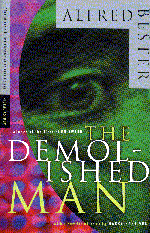
Alfred Bester, The Demolished Man

Taking a much-needed break from novels that exceed three-hundred pages and require thought, on Christmas morning I returned to one of my guilty pleasures: science fiction.

This Hugo Award-winning novel takes place in 24th-Century New York City, where mind-reading Espers ("peepers") mix with "normals" and help to regulate law enforcement. Consequently, crime has become virtually non-existent. Enter Ben Reich, one of the wealthiest New Yorkers and one who is willing to do anything -- even commit the first premeditated murder in eighty years -- to acquire the wealth of his business rival, D'Courtney. Enlisting the help of a couple of peeper acquaintances, Reich gets his hands on an ancient weapon -- a gun -- and locates D'Courtney in the midst of an elaborate parlor game at one of Maria Beaumont's elegant parties, only to find himself subsequently pursued by Esper cop Lincoln Powell in the party's aftermath.

Part detective novel, part Dostoyevskean meditation on crime and guilt, part Law and Order, and lots of paranoia a la Philip K. Dick with a Freudian undercurrent, The Demolished Man is a fun and fast-paced book that'll satisfy your old school sci-fi jonesin'.

Saturday, December 23, 2006


Charles Dickens, David Copperfield

Over the years, my experiences with this novel -- the quintessential Dickensian bildungsroman -- have been as varied as the life experiences of the title character himself.

Let's begin in 1987, when I was assigned to read the book in the late Professor Tom Deegan's British Literature seminar during my BA years at Saint Xavier University. Being the cocky twenty-one year old English major I was back then, I didn't bother to read it -- much like I didn't read Henry Fielding's Joseph Andrews in the previous semester's class taught by Professor Norm Boyer. In retrospect, I don't regret those decisions: I remember our class discussion of the Fielding novel lasting all of 15 minutes; I recall no discussion of the Dickens novel at all. So I didn't waste time reading a book that never got discussed at length anyways.

That copy of David Copperfield remained unread on my book shelf for years.

Fast forward to about ten years ago when, on a lark, I decided to read it ... and was hooked! It was by far the best book I'd read in years, and I still recall reading it in our old den -- the room that would eventually become my son's bedroom. My impressions of the book at that time were positive: it told a great story with passion and humor, yet also provided enough social commentary to remind you that you were reading a serious work of fiction. It was the perfect balance between the "fun" of early Dickens and the social critic of later Dickens.

And now I re-read it for my upcoming Newberry class, and yet another set of reactions.

As much as possible, I try to read the work in question during the preceeding term, assuming I'll then re-read it piecemeal with my students each week, thus bringing as close a reading of the text as I can in a short time span -- two full readings within several months. When I began Copperfield in the fall, it was pretty much what I remembered, but I wasn't exactly "enjoying" it. It lacked the "fun" I remembered from my reading a decade ago. So, having gotten about a third of the way through it, I set it aside and went directly to Bleak House -- a haunting and complex work. I toiled away for a month on it, and upon finishing I immediately started Thomas Pynchon's Against The Day -- a wacky and complex work. Upon finishing that book, I then resumed Copperfield.

Amazingly, now David Copperfield went down like a smooth glass of water. On the heels of two lengthy and difficult novels, David Copperfield read easily ... almost too easily ... and I'm most immediately struck by how our experiences with one text impact our experience with the next.

Regardless, David Copperfield remains a wonderful book! Enjoy it!


Happy holidays, by the way. I'm looking forward to acquiring lots of new books this holiday season!! May you do the same.

Thursday, December 14, 2006


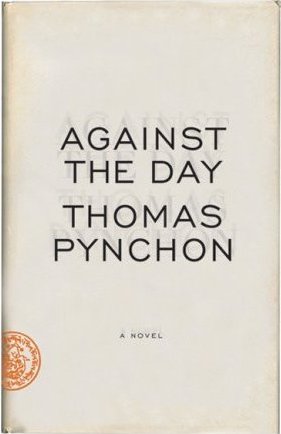
Thomas Pynchon, Against The Day

I started this book on Tuesday, November 21st (the day it was released) and just finished it today. Whew!

Years ago I received a copy of Gravity's Rainbow as a Christmas gift, and I've been hooked on Pynchon's works ever since! By turns profound and hilarious, goofy and infuriating, beautifully eloquent and downright nauseating, his novels depict a world rooted in historical facts that are judiciously seasoned with hippie-era paranoia, jazz-inflected song lyrics, fetishisms, talking animals, quirky dialogue, and more pop culture references than a Chuck Klosterman essay. And despite publishing only six novels over a forty year writing career, the elusive Grandfather of Postmodernism has given us what may potentially be his final novel -- and it's a whopper!

Against the Day has an elaborate, rambling plot that goes something like this: Webb Traverse is a Colorado miner who moonlights as the Kieselguhr Kid, a dynamiting anarchist. When robber-baron capitalist Scarsdale Vibe puts a hit out on Webb, the Traverse kids -- sons Reef, Frank, Kit, and daughter Lake -- set out on their own narrative trajectories in part to avenge Webb's death. Along the way, each of Webb's kids gets involved in separate adventures that weave in and out of each other's lives as well as history itself, including the 1893 Columbian Exposition in Chicago, the Tunguska Event of 1908 in Siberia, the Mexican Revolution, World War I, and the early years of the motion picture industry in Hollywood, among others. We also get Skip the ball lightning, Thorvold the tornado, a young Groucho Marx, a Viennese operetta entitled The Burgher King, the walking dead, Chinese things, tarot cards, and lots of mayonnaise ... and peering down upon the action at all times are the wonderful Chums of Chance, a quintet of ballooning aeronauts who drift throughout the narrative with their lovable Henry James-reading skydog, Pugnax.

What I found most fulfilling here is the way in which Pynchon manages to link this novel with his previous five novels, tying together underground postal systems with the beginnings of modern weaponry with speculation about civilizations below the earth's surface with simple father-daughter and parent-child relationships, never once losing typical Pynchon themes and motifs like corporate greed, political conspiracy, labor issues, and harmonica marching bands (trust me on this). Had I not read his earlier novels, this work might seem like a rambling mass of 1,085 pages of jibberish; having read the other books, this is an elaborate "singl[ing] up all lines" of the massive ongoing novel that is "the works of Thomas Pynchon."

Which is not to suggest, however, that only veterans of Pynchon's works will enjoy Against The Day. Au contraire, this novel is much more accessible than his ever-daunting 1973 masterpiece, yet more enjoyably complex than, say, The Crying of Lot 49 or Vineland. If ever a reader wanted to experience the wacky world of Pynchon and follow the story to boot, s/he might reasonably opt for Lot 49 or Vineland before attempting the Rainbow -- or, dare I suggest it, cut his teeth on Against The Day.

Let the reader decide. Let the reader beware. ; )

Tuesday, December 05, 2006


Charles Dickens, Bleak House

This was actually a re-read for me, since I read it a few years ago for the Biblioholics Anonymous. Nevertheless, it is one of the next novels in my chronological reading of Dickens's canon: I spent about five weeks reading it, and finished it on the evening before Against The Day was released.

When you read Bleak House, you realize that you're in the presence of a masterpiece. It comes to you from the darkest corners of the novel, where even the minor characters wield significance; it comes to you from the two separative narrative points of view, at first a bit jarring but, eventually, quite necessary; it comes to you from the setting, which transports you from the mud and fog of London's streets to the sterile arrogance of Chesney Wold to the pox-ridden delapidations of Tom-All-Alone's; it comes to you from the mysteries heaped upon mysteries -- the Chancery suit of Jarndyce and Jarndyce that grinds on ad infinitum, the deaths of a solitary military man and a prominant lawyer, the spontaneous combustion of a rag-and-bones shop owner, the parentage of an innocent young girl, and the sufferings of My Lady Dedlock. Throughout, mysteries are steeped in curiosities wrapped in enigmas.

The fun of Bleak House comes, in part, from watching those mysteries unfold (it is said that this is the first "detective novel," and paved the way for Wilkie Collins's The Moonstone and the fiction of Sir Arthur Conan Doyle). There is humor, but rather than the rambling, shambling slapstick of Pickwick, here you get the voice of Dickens the social satirist (via such unforgettable characters as Mrs. Jellyby and Mr. Turveytop, among others). And it is pure pleasure to watch Dickens navigate our reading through a myriad of settings and characters and plotlines, fulfilling our expectations here and subverting them there, all the while in a prose that is well-paced and beautifully rendered.

This was even better the second time around! It's long, but well worth it!

Sunday, December 03, 2006


Ben Mikaelsen, Touching Spirit Bear

Cole Matthews is a fifteen-year-old juvenile delinquent who, in an attempt to avoid jail time for savagely beating a classmate, agrees to spend one year living alone on a remote island in southwest Alaska to complete a Native American healing process called "Circle Justice." At first, Cole is defiant. He attempts to escape, and in an ultimate act of poor judgment charges a white "spirit bear," which promptly mauls him and leaves him for dead.

So begins this outstanding novel by Ben Mikaelsen.

Like so many YA novels, this is a story about an adolescent's "growing up" and becoming a better person by novel's end. What makes this work truly enjoyable, however, is the author's forays into Native American spirituality as he details the difficulty with which Cole must overcome his demons to achieve inner peace. Also, Cole's experiences are drawn from the author's own troubled youth and exposure to Circle Justice, so there is a voice of authenticity behind the writing that makes Cole's characterization all the more poignant.

By turns a gripping adventure and a compelling meditation on Life's tranquil beauty, Touching Spirit Bear is a great read! I highly recommend it.

* * * * * *

These last two months have been insane. Although I've done a ton of reading and have lots to post here, I haven't had the time or energy to do so lately. I will do what I can this week to catch you up on the things I've been reading.

The biggest literary news, of course, is the release of Thomas Pynchon's 1,085-page tome Against The Day on November 21st. I'm trying to read about thirty pages a day in order to finish it by Christmas. As of today, I'm up to page 428. It's an incredible book. As I read the novel, I hope to contribute to the PynchonWiki as well as Pynchon-L's group reading of the novel starting in January, 2007. More to follow.

Monday, September 04, 2006


Matthew Battles, Library: An Unquiet History

This book is essentially a history of the development of the library, from its earliest beginnings in Mesopotamia to the public library we use today. But it's much more. In elegant prose, Battles regales the reader not only with the "stories" of major developments in library sciences over the centuries, he also gives you loving descriptions of the ways in which books have been handled, bound, and catalogued as well as fascinating character studies of the many people who contibuted to developments in the library sciences: Aristotle and Cicero, John Harvard and Jonathan Swift, Melvil Dewey and Alfred Kazin, among others.

Library: An Unquiet History is further filled with trivia for the eager bibliophile, such as phony titles from Dickens's "false facade" collection, titles from books that exist only in literary works, descriptions of the personal libraries of famous writers and thinkers, even details on how the role of the librarian has changed over the centuries.

Interestingly, one thing that emerges from Battles's writing is an appreciation of the fragility of the library and the intellectualism for which it stands. In retrospect, the history of the library is really the history of its destruction and the suppression of its works, whether at the hands of a Julius Caesar or a Joseph Goebbels. But like a phoenix emerging from its own ashes, the library is testament to the endurance of intellectualism in the face of fundamentalism, demagoguery, and military might.

This is an interesting and well-written work of non-fiction that I enjoyed. You will, too.