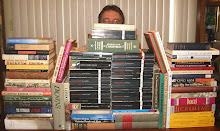
"My Date with Dostoyevsky" - Part II
Well, the best laid plans o' mice and men oft' go awry ... My original plans to read The Brothers Karamazov one chapter per day (and thus finish it by Halloween) have slowed considerably, not only due to reading a dozen other things simultaneously for school, the Newberry, the Biblioholics A, and pure fun, but also because The Brothers K simply cannot be rushed at such a daily pace. In two months' time I have managed to finish the first four books ... roughly just short of a third of the novel ... and while I will not achieve my "goal" in terms of time, I have come to appreciate just why this novel is considered a masterpiece!
Talk about a novel that is totally character-driven! What is interesting is that Dostoyevsky was a huge fan of Dickens's novels, but there is little similarity between the two. The Brothers K has a plot that crawls, but that's fine ... He pauses on each character, whether major or minor, and allows each one to philosophically interact with others. So while an entire section of the novel (say, Book II) has very little in the way of action, the philosophical complexity and characterization fuel the reading experience!
For several years now, I've been intrigued by the ways in which certain authors demand a particular method (or style) of reading. Milton seeks a "fit reader," but the way you read Joyce is different from the way you read Pynchon, and the way you read Dickens is clearly not the way you read Dostoyevsky. So as I read and teach Paradise Lost and Little Dorrit, and enjoy Naguib Mahfouz and David Foster Wallace, I must shift into fourth for evenings with Dostoyevsky! : )
Great stuff so far!
Monday, October 08, 2007


Thursday, October 04, 2007

Katherine Paterson, Bridge To Terabithia
Just finished this book, having read a chapter a night with my ten-year-old son. This is also our November selection for the Biblioholics Anonymous. Either way, it's a great book, but it's not at all what I expected.
For some inexplicable reason, I expected a fantasy novel along the lines of C.S.Lewis's The Lion, The Witch, and the Wardrobe. I have absolutely no justification for expecting that ... maybe it was something about the title. Nevertheless, I was surprise to find that it was essentially the story of a ten-year-old boy named Jess Aarons, a loner who aspires to be the "fastest runner in the fifth grade" until he befriends Leslie Burke, a free-spirit who introduces him to confidence, compassion, and the value of occasionally visiting a "secret place" that only they can go to in the nearby forest -- a place without adults and rules, a place of pure escape: Terabithia. While their visits are initially punctuated by brief episodes of individual growth, it's not until tragedy strikes that Jess is able to see the true value of Terabithia.
This is a powerful book! Check it out!
Monday, October 01, 2007

Kathy Acker, Great Expectations
Truth be told, the jury's still out on this one ...
Recently, one of the folks on Pynchon-L mentioned the works of Acker (whom I had never heard of) and said that fans of Pynchon would like her work. After searching a bit at the local bookstores, I was able to special order a copy of Great Expectations, which the lister recommended was a good book to start with.
Part surrealistic cut-up method a la William S. Burroughs; part plagiarized text which draws heavily from Dickens's Great Expectations, The Story of O, Keats poetry, and a wild assortment of other traditional and contemporary works; part confessional memoir of a punk-ethos author; part compellingly poetic but obscenity-charged erotica -- Acker's work is not a "novel" in the conventional sense. Told through a PoMo collection of fragmented narratives that weave together other literary works with Acker's own reflections on (among other things) her mother's suicide, I found myself likening the reading experience to that of Burroughs's Naked Lunch with a touch of Gertrude Stein's experimental punctuation and sentence structures. And while many passages might have been shocking back when the work was published in 1983, I found much of the obscenity quaintly reminiscent of the Beats.
But what I thought most compelling here was the plagiarism, apparently a "technique" that Acker was known for -- lifting passages almost verbatim from a wide variety of texts and somehow weaving them together with her own narrative to create an entirely new work of art -- sort of the literary equivalent to "sampling." And since sampling music gained popularity in the Eighties through such bands as 2 Live Crew and Big Audio Dynamite (anyone remember those bands? LOL!), it would make sense that her compositional method ran concurrent with underground (and emerging mainstream) music at the time.
I'm not entirely convinced that a fan of Pynchon will enjoy the writing of Kathy Acker ... but I would be willing to check out one or two other novels by her to see if there is depth and breadth to her narrative technique. Other novels by Acker can be found here.
Thursday, September 27, 2007

Scott O'Dell, Island of the Blue Dolphins
As I continue to look for good novels that I can read with my freshman students, I find that this one is pretty good. Based loosely on a true event, the protagonist is Karana, a native Polynesian girl in the village of Ghalas-at whose life is remarkably altered when a shipful of Russian sailors descend upon her island to hunt sea otters and, when forced to pay for the skins, brutally murder many of the villagers. When a ship of allies later comes to transport her people to a safer location (and forgets to bring her brother), Karana leaps from the ship and returns to the island in the hopes of living with her brother until another ship arrives. But a pack of wild dogs quickly changes those plans.
Forced to live alone on the island, the majority of the novel traces Karana's years on the island as she builds a shelter, hunts devilfish, domesticates wild dogs, survives an earthquake, and learns the value of balancing survival with a respect for the natural order of animal life.
But what I especially liked about this little book is that it departs from the typical "protagonist-changes-for-the-better-over-the-course-of-the-novel" formula that seems to dominate so much of current YA literature (or at least the works I've read ... see my February 4, 2007 blogspurt re: Fever). Karana is a strong and independent character from the start, and her isolation on the island merely affords additional ways through which she can exhibit that strength and independence. And it's SO nice to finally have a female POV that isn't cluttered with whininess and a nauseating obsession with boys!
This is a good book, especially for younger readers. Check it out.
Sunday, September 23, 2007
 Charles Dickens, Hard Times
 Hard Times is the closest Dickens ever came to writing poetry. Despite his difficulties working within the medium of a weekly periodical (something he hadn't done since Barnaby Rudge, written some dozen years earlier), the prose sings with metaphor and imagery, puns and parallelism. It's his least "happy" novel, but stylistically it shimmers like a blade in the sun.
The novel is Dickens's examination of various social concerns during the mid-1850s: Utilitarian educational practices, labor disputes, marital conventions, social reform, etc. Coming on the heels of Bleak House, Hard Times is bleaker. Marriages end, "villains" go unpunished, and innocents die. But somehow the notion of "hope" is rendered plausible within the stark, gray landscape of Coketown, thanks in no small part to a young girl and the circus from which she comes. And Dickens's prose -- magical and musical in its melancholy -- seems perfectly suited to a story "for these times."
It was fun re-reading this novel for my upcoming Newberry class!
Thursday, August 16, 2007

"My Date with Dostoyevsky"
I've had a taste for Dostoyevsky lately ... Haven't read any of his works in a long time. So I decided to read The Brothers Karamazov, one chapter per day. The chapters average about ten pages in length each, and with 93 chapters and reading one chapter per day I'll finish it by Halloween.
I started this past Sunday night. Wish me luck! : )
Thursday, August 09, 2007

Valerie Browne Lester, Phiz: The Man Who Drew Dickens
It's been a fairly productive year of reading non-fiction for me so far, and I can add this one to the list. Having taught Dickens now for about three years at the NL, it is to each novel's illustrations that I find myself increasingly drawn, and this "family biography" of Dickens's principle illustrator, Hablot Knight Browne (a.k.a. "Phiz"), is an enjoyable introduction to a study of his life and work.
The author is the great-great granddaughter of Phiz, and in the book's epilogue and acknowledgements she details the lengths to which she had to dig for information on the famous illustrator, unearthing along the way some fascinating facts heretofore unknown to H.K. Browne scholars (e.g., Phiz was an illegitimate child, fathered by a visiting soldier in Napoleon's army). While Lester does a mediocre job of handling Phiz's youth and years leading up to his collaboration with Dickens in 1837, she does a fine job of analyzing the development of his artistic style over his years with (and after) Dickens. Perhaps the best part of this book is the abundance of illustrations, sketches, oil paintings, doodles, and watercolors that are reproduced throughout, giving the reader a wonderful view of Phiz's artistic range. And since I have only ever seen his illustrations for Dickens, this was well worth the price of the book.
Capturing a time when books were painstakingly illustrated and printed with care and affection, the book also portrays nicely the intricate relationship between author and illustrator. The relationship between "Boz" and "Phiz" illustrates the ways in which both author and artist depended upon each other for the success of a book's sales, and by contrasting that working relationship with the other authors for whom Phiz contributed works throughout the years, you gain a better appreciation for this archaism of the publishing world.
Though it's hardly an exhaustive study of Phiz's life and works, Lester's book is a good start if you're interested in this sort of thing.
Tuesday, July 31, 2007
 J.K. Rowling, Harry Potter and the Deathly Hallows
I was fortunate this month to enjoy two excellent reads: first, Stephen King's The Stand ... and now, the latest and last Harry Potter novel, Harry Potter and the Deathly Hallows. And what a great piece of fiction this one is!
Set in Harry's seventh and final year at Hogwarts, surprisingly little actually takes place at the renowned School of Wizardry as Harry, Ron, and Hermione engage in a series of adventures to fulfill Dumbledore's final directive: locate each remaining Horcrux hidden by Voldemort in his attempts to scatter his power and, in so doing, defeat him. Although the school itself becomes the setting for a final showdown, the reader is gratefully spared the boring class projects and Quiddich matches that encumber the previous six books; instead, the reader is here treated to adventure after edge-of-your-seat adventure ... the magic is darker, death is a realistic threat (as several characters we've come to know and enjoy actually perish), and the stakes are at their highest!
Among Pott-heads, however, I'm going to guess that this book is the most fulfilling of the series. For me, I especially enjoy the ways in which Rowling alters her style with each successive book, and Deathly Hallows is simply a piece of expert storytelling, bringing the reader through each adventure with superb pacing. For my money, "The Muggle-Born Registration Commission" and "Gringotts" are two chapters that best exemplify the way in which Rowling has developed as a writer of suspense.
And in addition to the subtlety of the humor, I also enjoy the social commentary that Rowling has made a staple of the series, addressing such topics as racism, sexism, education (both in terms of effective teaching strategies and the perils of politicized educational systems), war propaganda, the media, and (most directly in this book) the functions of fear within a society. As a good author of fantasy or sci-fi must, Rowling avoids becoming didactic and merely leaves the characters themselves to work thru the issues, permitting the reader to form judgments within the comfort of the "wizardry" context.
And like Stephen King's The Stand, Rowling likewise gives us a mammoth narrative that in so many ways is indebted to both Tolkien and Dickens. Like the best of Dickensian fiction, Deathly Hallows brings together many different characters and components of the earlier novels (e.g., the various spells, the Sorting Hat, the Chamber of Secrets, the Whomping Tree, Dobby and Grawp, etc.) to make its resolution all the more satifying. And anyone who has ever read The Lord of the Rings will detect elements of the Lady Galadriel's "gifts," the Grey Havens, the siege of Gondor, and any number of other Tolkien influences.
But ... when everything is said and done ... this was a fun and thoroughly satisfying conclusion to the Potter series, and (in my opinion) it solidifies the entire saga within our literary canon. A great, great book!
* For the record, I am one of the few readers I know who chose to not read the whole darned thing in the 24-hours immediately following its release. I wanted to savor this last drop of Potter vintage. ; )
Sunday, July 22, 2007

Stephen King, The Stand
Back in high school and my early college years, Stephen King was one of my favorite authors. I read Carrie, Cujo, Firestarter, The Shining, and (my personal fave) Misery in two- or three-day marathon sessions, savoring all those wonderful pop culture references and page-turner suspense sequences, not to mention the occasional literary allusion or two (he was, after all, a former English teacher!). But The Stand -- most likely due to its length -- didn't interest me.
For this month's Biblioholics Anonymous group read, we chose The Stand ... and I must admit, I should have read this book years ago. One of the best pieces of fiction I've read so far this year, the novel is gargantuan in length and scope, yet based on a simple premise: the end of the world.
Set in the United States in 1990, the novel recounts the effects of an accidental outbreak of a man-made plague -- later called the superflu -- which essentially wipes out 99.8 percent of the world's population. Those who are mysteriously immune to the superflu find themselves first wandering to make sense of the desolation, then later inspired by strange dreams to journey west, eventually gathering in Boulder, Colorado (those who dream of the saintly Mother Abagail) or Las Vegas (those who dream of and are drawn to the villainous Randall Flagg). The novel focuses on several characters from different parts of the country as they make their way to their respective locations.
Once gathered in Boulder, this group comes to realize that Flagg's evil forces are gathering in Las Vegas and are planning to wipe them out. Mother Abagail instructs four of the main characters to travel to Flagg and engage in what will ostensibly become the final cosmic stand between Good and Evil!
This is a fun and engaging piece of post-apocalyptic literature that has its roots in Tolkien's The Lord of the Rings, but is likewise Dickensian in its ability to begin with several narrative trajectories that are seemingly disconnected and, as the story progresses, those storylines merge brilliantly and bring perfect resolution to the narrative. It's a long book (the "complete and uncut" edition is 1,141 pages), and some of the pop culture references may strike you as antiquated, but the story is phenomenal!
It took me almost three weeks to read this (begun in Mexico, finished in Kentucky), but it's well worth it. Enjoy!
And now ... on to Harry Potter and the Deathly Hallows! : )
Saturday, June 30, 2007

Charles Dickens, Little Dorrit
Of all the Dickens novels I've read thus far (and I've now read twelve of 'em), this was, without a doubt, the roughest one to get through. Maybe it was the timing: I had just finished teaching a ten-week course on David Copperfield and Bleak House -- which is the equivalent of eating a seven-course meal at a German shmorgasbord -- and I was either too Boz'ed out to attempt another one of his 900-page tomes, or I was still reeling from the sublimity of Copperfield and Bleak. Regardless, I spent a good three months pluggin' away at this bugger, and I found Little Dorrit extremely difficult to get into, let alone enjoy at any level whatsoever.
The title character is the daughter of William Dorrit, an insolvent who has been long imprisoned in the Marshalsea for debts unpaid. His daughter Amy is born and raised within the confines of the prison, and the first half of the novel focuses on numerous characters as their trajectories weave in and out of that of Dorrit, the "Father of the Marshalsea." Due to a mysterious and coincidental stroke of fortune, Dorrit falls into wealth ... and the second half of the novel follows the same peripheral characters as they move in and out of Dorrit's newfound circumstances outside the walls of the debtors' prison.
In a way, Dickens is at his subtlest here, working with a fairly simple theme -- imprisonment -- but exploring carefully the nuances of that theme as they affect the lives of the wealthy, the destitute, the young and old, the villainous and innocent. Unfortunately (for me, at least), I found few characters who were likeable (except for the one everyone seems to delight in, Flora Finching), I thought the plot was too plodding and convoluted, and there were far too many instances of Dickens "telling" us what to think rather than "showing" us -- as if, late in his literary career, he had developed the neophyte's habit of beating the reader over the head with his social commentary.
In Dickens's defense, I also get the disinct impression that I simply didn't give this book a fair shake ... that for whatever reason I just wasn't ready to read this novel and gluttonously forced it down before I'd let the previous two digest properly. Now I'm suffering for it in the bathroom. Make of that metaphor what you will ...
Thursday, June 28, 2007

Bill "Spaceman" Lee and Jim Prime, Baseball Eccentrics
As those who know me know, we're a baseball-lovin' family here, we are. So it was completely in-character for my wife to get me the Spaceman's Baseball Eccentrics as a Father's Day gift. I read the whole thing in about one day!
Baseball is a sport that lends itself beautifully to storytelling, and here the wacky Lee doesn't disappoint! Focusing on the various "flakes" and eccentrics who have populated baseball over the decades, Lee provides generous helpings of old standards like Casey Stengel, Yogi Berra, Leo Durocher, and my personal fave: Mark "The Bird" Fidrych (I can still remember my father laughing at the TV when I was a kid back in 1976, watching Fidrych "talk" to the baseball!). But Lee also describes the eccentricities of more revered players (e.g., Satchel Paige, Barry Zito), players who delighted in practical jokes (Moe Drabowsky, Jay Johnstone), those who observed strange superstitions (like Kevin Rhomberg who, during his three years with the Cleveland Indians back in the early Eighties, superstitiously believed that every time he was touched by another human being, he had to touch that person back -- often with hilarious results!), and a wide variety of jokesters, irate managers (Earl Weaver, anyone?) and, of course, Bob Uecher! And while some of the stories may be familiar to you, Lee maintains a nice, conversational style that enhances the witty storytelling.
This was pure, mindless entertainment. If you or a friend/family enjoy baseball lore, this is a fun book!
Wednesday, June 27, 2007

Harriet Rubin, Dante in Love: The World's Greatest Poem and How It Made History
This is a pretty good supplement to any reading of Dante, whether it be just reading Inferno or the entire Divina Commedia for the first time. While I'm not too crazy about the title (which suggests a focus on Italian poet Dante Alighieri's love for his Beatrice a la Shakespeare in Love), the scholarship is well done and, like the Peter Ackroyd biography of Shakespeare I read earlier, it provides an excellent portrait of the poet, his times, and his writing method.
Rubin begins by putting Dante within his political context, detailing the circumstances surrounding his exile and the nineteen years of wandering he was subjected to as a result. She adds to this a solid analysis of each of the Commedia's three canticles, discussing Dante's compositional methods and influences (whether real or literary), all the while linking Dante's development as poet and man to his developing sense of "love" -- love for Beatrice, love for country, and love for God. Ideally, I would have liked to read Inferno in its entirety, followed by Rubin's section on it; then read Purgatorio in its entirety, followed by Rubin; followed by Paradiso and Rubin. As I said, for students of Dante this is a good book ... maybe not the best, but a good starting point for putting the Commedia within some authorial and historical context.
If you have a chance, check it out.
Sunday, June 10, 2007

The Literature of Hell
This summer, I'm teaching an eight-week seminar at the Newberry Library called "A Gathering of Shades: Exploring the Literature of Hell," a class I developed and taught there a few years ago based essentially on many of the literary works we read in A.P. English. In this seminar, we read exerpts from the Epic of Gilgamesh, the Book of Job, Homer's Odyssey (Book 11), Virgil's Aeneid (Book 6), and Books I and II of John Milton's Paradise Lost. In terms of complete texts, in the seminar we read Aristophanes's The Frogs, Dante's Inferno, Mary Wollstonecraft Shelley's Frankenstein, Samuel Taylor Coleridge's "The Rime of the Ancient Mariner," Jean-Paul Sartre's No Exit, Albert Camus's "The Myth of Sisyphus," and Samuel Beckett's Waiting For Godot. It's hell ... but it's fun stuff!
Over these next two and a half months, however, I have several books that I've collected over the years as desk references for a course such as this, and as I teach each weekly session these are the books I have open on my desk and find myself re-reading in snatches:
Alice K. Turner, The History of Hell -- This is an easy-to-read and entertaining survey of all things Hell-related throughout literature, and includes some fabulous photos and artwork to enhance the reader's understanding of how Hell is reflected in the arts (later chapters draw upon how film and music are influenced by literary visions of Hell).
Edward J. Ingebretsen, Maps of Heaven, Maps of Hell: Religious Terror as Memory from the Puritans to Stephen King -- Given the literary works I teach in the seminar, Ingebretsen's text is not really useful. But his discussions of early American "terror" and how it influenced the writings of Emerson, Hawthorne, Frost, H.P. Lovecraft, and Stephen King serve more as reference than anything. I think this book is currently out-of-print. I scored a copy at Powell's Books in Portland, Oregon!
I.P. Couliano, Out of This World: Otherworldly Journeys from Gilgamesh to Albert Einstein -- Another well-written survey text, it helps the reader understand aspects of the afterlife as they pertain to Buddhism, Judaism, and Shamanism. Very accessible!
Alan E. Bernstein, The Formation of Hell: Death and Retribution in the Ancient and Early Christian Worlds -- Probably the most comprehensive and scholarly of the texts here, its focus is limited to the eras mentioned in the title, but the depth of analysis is staggering! This was another gem I found at Powell's Books in Portland. I seem to remember its being hard to find elsewhere.
Ronnie H. Terpening, Charon and the Crossing: Ancient, Medieval, and Renaissance Transformations of a Myth -- This one was perhaps the most difficult to obtain. Its been in and out of print in the last few years, and appears to be the sort of text that is printed in limited editions solely for university library collections. The focus is on the ancient boatman who traverses a river to bring souls to the underworld - a myth that can be traced through numerous religions and takes on various forms. It's a fascinating study and definitely a book worth getting for the serious Hell scholar in your family.
Mary Roach, Spook: Science Tackles the Afterlife -- Roach is a wonderfully amusing writer whose examination of the uses for corpses in Stiff I mentioned some time ago on this blog. In Spook, she tackles various scientific methods that have been used throughout history in an attempt to "prove" the existence of the human soul and an afterlife ... and while I found this book somewhat less interesting than Stiff, her tongue-in-cheek humor keeps the whole thing moving nicely!
So if the study of Hell is your thing, you can do one of two things: spend a day at your local DMV or, better yet, check out these books!
And if you like Hell-related music, click here. Enjoy!
Thursday, June 07, 2007

Philip Freeman, Running the Voodoo Down: The Electric Music of Miles Davis
While I lack the expertise and foundation in musical theory to fully understand when jazz critics discuss such things as time signatures and "polarity of rhythm" and "artificiality of methodology" and such abstractions, I knows what I likes when it comes to jazz ... and I've always liked Miles Davis. And the nice thing about Freeman's book is that he doesn't burden the reader with abstractions.
Focusing on Davis's fusion period from 1967 thru 1974, Freeman offers a series of extended essays that explore the various ways in which Miles stretched the boundaries of what was considered "acceptable" (or even listenable, for that matter) both within and without the jazz community. By experimenting with personnel lineups, drawing from such influences as Jimi Hendrix and Sly and the Family Stone in terms of sound and song structures, fostering oft times vitriolic relationships with fellow musicians and his producer, Teo Macero, and continually searching for new ways to push the limits of both the musician and the listener, Miles Davis was able to create a body of work within that short period that would immediately influence his peers within the jazz community (like Herbie Hancock or John McLaughlin) and artists within the prog rock community (Yes, King Crimson, etc.), and influence the likes of pop, rap, hip-hop, ambient, and rock artists in decades to come.
By the way, another book I've read that handles this era well is Paul Tingen's Miles Beyond: The Electric Explorations of Miles Davis, 1967 - 1991. Do check that one out as well.
Tuesday, May 29, 2007

Peter Ackroyd, Shakespeare: The Biography
The end of the school year always brings with it the promise of catching up on some "fun" reading over the summer, and here's a book that's been sitting on my home stack of Books-To-Read since February.
My first encounter with Peter Ackroyd's work was a few years ago, when I began reading his biography of Charles Dickens piecemeal to supplement my research for the Dickens seminars. His prose is beautiful and engaging, and writes biography like a novelist (which he is, too). In Shakespeare: The Biography he does an excellent job of capturing not only the Elizabethan zietgeist, but also handles well the facts and fictions surrounding the life of the Bard, from his humble beginnings as a country schoolboy to his astonishing rise to prominance as the leading London playwright of his time. Along the way, Ackroyd peppers his narrative with interesting anecdotes on Will's writing process, his financial affairs, his personal relationships with actors and rival playwrights, and the ways in which his life's details found their way into his dramatic art.
I especially appreciate the way in which Ackroyd handles the more "controversial" aspects of Shakespeare scholarship. When discussing such things as the authorship question, or Shakespeare's religious leanings, or even the question of to whom the sonnets are dedicated -- all hot topics that Bard scholars have debated ad nauseum for years -- Ackroyd merely puts forth the facts surrounding each topic and avoids turning his biography into a platform from which to espouse yet another "theory." If anything, Ackroyd shuns conspiracy theory for the simple contention that Shakespeare was a gifted literary artist who was financially savvy, politically conservative, and merely one of countless playwrights at the time who worked hard to write, stage, and perform their work within the entertainment districts of London in spite of monarchal censorship and constant outbreaks of the plague.
This was interesting and accessible! I highly recommend it!
Thursday, April 12, 2007

R.I.P. Kurt Vonnegut, Jr.
A sad day in the literary world ...
Here is the Associated Press article:
NEW YORK - In books such as "Slaughterhouse-Five," "Cat's Cradle," and "Hocus Pocus," Kurt Vonnegut mixed the bitter and funny with a touch of the profound.
Vonnegut, regarded by many critics as a key influence in shaping 20th-century American literature, died Wednesday at 84. He had suffered brain injuries after a recent fall at his Manhattan home, said his wife, photographer Jill Krementz.
Vonnegut's more than a dozen books, short stories, essays and plays contained elements of social commentary, science fiction and autobiography.
"He was sort of like nobody else," said fellow author Gore Vidal. "Kurt was never dull."
A self-described religious skeptic and freethinking humanist, Vonnegut used protagonists such as Billy Pilgrim and Eliot Rosewater as transparent vehicles for his points of view.
[...]
Vonnegut once said that of all the ways to die, he'd prefer to go out in an airplane crash on the peak of Mount Kilimanjaro. He often joked about the difficulties of old age.
"When Hemingway killed himself he put a period at the end of his life; old age is more like a semicolon," Vonnegut told the AP.
One of the best quotations from Vonnegut comes from this article from the New York Times:
[...] To Mr. Vonnegut, the only possible redemption for the madness and apparent meaninglessness of existence was human kindness. The title character in his 1965 novel, "God Bless You, Mr. Rosewater," summed up his philosophy:
"Hello, babies. Welcome to Earth. It's hot in the summer and cold in the winter. It's round and wet and crowded. At the outside, babies, you've got about a hundred years here. There's only one rule that I know of, babies - 'God damn it, you've got to be kind.' " [...]
Monday, April 09, 2007

David Shenk, The Immortal Game: A History of Chess
When my son Matthew was six years old, I taught him how to play chess.
Today, as a ten-year-old chess player, he's pretty good and has competed in a few tournaments. Like bowling and baseball, I hope that chess will become a lifelong interest for him and, some day, be one of the things he'll teach his own children.
This past fall he participated in his school's chess club, which prompted me to look into a few books related to chess strategy, openings, endgames, and -- most interesting to me, personally -- the history of the game.
Shenk's The Immortal Game is an excellent read for anyone who is not only intrigued by the game's centuries of development, but also interested in the pragmatic tactics of specific matches. Shenk provides a readable account of the game's development, from its origins in Persia and Egypt through its growth in medieval Europe to its metaphorical significance throughout modern history, all the while exploring the game's unique hold on the human mind at particular points in history: the significance of how the pieces developed over time (e.g., the "Bishop" was once the "Fool"), the ways in which the game came to represent the human condition at certain historical moments (e.g., the Enlightenment's distaste for monarchy led to the development of Pawn importance), and a variety of such innovations to a game that has captured the hearts and minds of players for centuries.
Interspersing the history, Shenk focuses on the play-by-play action of the "Immortal Game," an actual match that took place in London on June 21, 1851 between Adolf Anderssen and Lionel Kieseritzky, two of the world's top chess players at the time. By giving the reader an actual competition to follow, the author maintains two narratives simultaneously: the "big picture" history of the game, and the "personal" account of how the game is opened, developed, and won (or lost) via its manipulation of time, space, and simple human skill.
If you dig chess, this is a great read! The Immortal Game comes with an accompanying website (and I'm hoping to beat my esteemed colleague after over a month of play action!). Check them both out!
Um ... and for a quick chess fix, go here.
Enjoy!
-----------------------------------
P.S. It's spring break and, between re-reading both Beloved and Bleak House, I'm hoping to squeeze in a Philip K. Dick novel and a Miles Davis biography. Wish me luck!
Monday, February 19, 2007

Cormac McCarthy, The Road
Simply put: haunting and gut-wrenching.
A man and his young son traverse the ashen wastelands of what was once America. Nuclear holocaust has devastated everything save a few roads and the occasional farm or abandoned city, and the two nameless protagonists move relentlessly westward in the hopes of reaching the ocean coast, all the while scavanging for food and shelter, or avoiding cannibalistic marauders.
Unlike McCarthy's masterpiece, Blood Meridian, there is no cast of colorful characters, no gruesome episodes of seemingly senseless violence, and no satanic Judge Holden from which to ascertain a moral (?) center. The Road is richly poetic despite its simplicity of style, and the "adventures" (such as they are) show a noticeable depth of character in both man and son as the narrative progresses. And while this is hardly the "feel good" book of the year, it remains surprisingly hopeful in the face of all that you, as a reader, suspect will happen by novel's end.
It took me about one full day to read this novel. It will grip you firmly about the neck during the reading, and linger with you long afterwards ...
Most powerful thing I've read so far in 2007, quite frankly! Check it out.
Sunday, February 18, 2007

Naguib Mahfouz, Palace Walk
Here's a book that I finished last week for February's Biblioholics Anonymous gathering. It was quite an enjoyable read!
Palace Walk may seem like an antiquated throw-back to the great Victorian novels of old, with its brilliant evocation of a faraway setting and its exotic characters. Yet it tells a compelling story -- that of Ahmad Abd al-Jawad, respected middle-class merchant to friends and acquaintances, but fiery-tempered patriarch to his own family. The novel, which is actually Book One of Mahfouz's "Cairo Trilogy" and is set in Egypt just after WWI, centers around al-Jawad, a highly traditional husband and father who maintains strict control over his family by way of the Qur'an while joyously seeking the pleasures of nightly trysts and carousing with friends. When his subserviant wife Amina dares to leave the house one day during his absence to visit a local shrine, she is involved in an accident that she cannot hide from her husband (and his fierce temper). One by one, wife and children must cope with the father's temper and hypocrisy as the novel takes us through marriage ceremonies, British occupation, and even family tragedy.
Here's a book that I finished last week for February's Biblioholics Anonymous gathering. It was quite an enjoyable read!
Palace Walk may seem like an antiquated throw-back to the great Victorian novels of old, with its brilliant evocation of a faraway setting and its exotic characters. Yet it tells a compelling story -- that of Ahmad Abd al-Jawad, respected middle-class merchant to friends and acquaintances, but fiery-tempered patriarch to his own family. The novel, which is actually Book One of Mahfouz's "Cairo Trilogy" and is set in Egypt just after WWI, centers around al-Jawad, a highly traditional husband and father who maintains strict control over his family by way of the Qur'an while joyously seeking the pleasures of nightly trysts and carousing with friends. When his subserviant wife Amina dares to leave the house one day during his absence to visit a local shrine, she is involved in an accident that she cannot hide from her husband (and his fierce temper). One by one, wife and children must cope with the father's temper and hypocrisy as the novel takes us through marriage ceremonies, British occupation, and even family tragedy.
It is often said that Mahfouz does with Cairo in his fiction what Dickens did with London or Dostoyevsky did with St. Petersburg in their respective works. He offers an objective glimpse into the minds and hearts of his characters, and in the process exposes the universality of their culture, religious beliefs, and overall value system -- things which may seem remote and alien to Westerners, especially in these times.
If you are looking for a multi-cultural novel that shows just how dysfunctional all families can be, Palace Walk is a good pick. In fact, I place this book on the same "family dysfunction" shelf as Anne Tyler's Dinner at the Homesick Restaurant and Louise Erdrich's Love Medicine.
(I plan to read Book Two of the Cairo Trilogy -- Palace of Desire -- later this year.)
Saturday, February 10, 2007

Rachel Cohn & David Levithan, Nick & Norah's Infinite Playlist
A colleague recommended this book to me.
Said colleague mentioned that it's a book which has received many accolades since its publication last year, and it epitomizes what "young readers really look for in a good book."
Apparently, young readers must look for pseudo-hip dialogue that ridiculously drops the f-bomb like a comma; emotionally needy narrators who dwell on their insecurities and continuously wonder if they're homosexual; a storyline that takes place over the course of one night (James Joyce, anyone?) and is told through the alternate-chapter points-of-view of the two protagonists (William Faulkner, anyone?); and fiction that succeeds in doing little more than capture the ranting zietgeist prattlevoice of the typical adolescent boy and girl as it whines about music, parents, sex, substances, sex, insecurities, and sex.
Nick & Norah's Infinite Playlist tells of one night in the life of the title characters, two Manhattan high school seniors who have just emerged from failed relationships and come to meet at a performance of their favorite band. Complete strangers when they hook-up in an effort to make Nick's ex jealous, they begin a long night of conversations and meanderings through the streets of New York City, confronting their own obsessions, insecurities, and issues as their relationship develops.
It's an entertaining premise for a story, and the authors execute the storytelling in a back-and-forth manner which would seem clever and innovative to less erudite readers. If anything, each of the two narrators has a distinctive voice, and their musings are sprinkled with pop culture references galore, and enough obscenities to pass as a realistic slice-of-life of the average adolescent: Charles W. Chestnut capturing 2007 teen angst, if you will.
But "good" books do more than merely entertain you with a slice-of-life. They do more than offer what you already know. They teach. They inspire. They affirm. They challenge. One would hope that they make you a slightly ... oh so slightly ... "better" person by the end of the reading because they've taught ... or inspired ... or affirmed ... or challenged. And here is where Nick & Norah fails: it panders precisely to what young readers know already (and the more insecure ones will want vindicated), but it doesn't transcend beyond that. Even by the time the couple come to learn the Jewish concept of tikkan olam, it's too little too late.
Sadly, reading this book was one of the most misspent two hours of my week.
Subscribe to:
Posts (Atom)